Search This Blog

Sunday, June 8, 2014

Book review: Melissa Cookston's "Smokin' in the Boys' Room"


Viewers of the popular television program “BBQ Pitmasters” are familiar with brash, cocky celebrity judge Myron Mixon, who always is introduced as the “Winningest Man in Barbecue.” 

But Melissa Cookston, a frequent contestant and judge on the show and a three-time whole hog champion at Memphis in May, easily can say she’s put out a new cookbook that is superior in content, detail and flavor to Mixon’s and many other "good old boys."

“Smokin’ in the Boys' Room (Andrews McMeel Publishing)” not only provides information that instills confidence to the novice and experienced barbecuers alike, but it also shares excellent insights about replicating Mississippi Delta delicacies and deserts, including Meyer Lemon Pie (Yum!).

Cookston doesn’t need to bill herself as the “Winningest Woman in Barbecue;” but her female perspective doesn’t hurt. In the book’s 180 pages, she comes across as warm and encouraging. She never assumes that you know too much and never dumbs down the text either.
 
The co-owner of MemphisBarbecue Company restaurants in Horn Lake, Miss., and Fayetteville, N.C., Cookston has been serving up barbecue since 1996, when she entered her first barbecue competition with her husband Pete.


From the first chapter, Cookston offers details missing from testosterone-fueled tomes, such as information about what to stock in your pantry, the tools she’d rather not do without and several practical tips.


Before getting to the meats, “Smokin’ in the Boys' Room” provides recipes for rubs and seasoning blends for grilling, marinades and sauces and the tools you'll need.


“My barbecue and cooking are about building layered tastes that unite on the palate to create a wonderful full-flavored effect,” she suggests. “I tell every judge to put a little sauce on his or her finger, then on the front of the tongue. The flavor should travel all across the palate – a little sweet, a little acid, a little salt and kick at the back to tell you it was there!”


It’s the kind of practical advice anyone can use.


Wednesday, June 4, 2014

New book "Eat Dat" offers readers an excellent guide to New Orleans' food culture, both pre- and post-Katrina


Michael Murphy was an outsider, something he acknowledges in his author’s note introducing his fabulous new book, “Eat Dat New Orleans: A Guide to the UniqueFood Culture of the Crescent City (Countryman Press).”


Like me, Murphy is a Midwesterner who grew up in the 1960s “raised on Steak ‘n’ Shake and Chicken in a Biscuit.” He moved to New Orleans just five years ago, too long after his first visit there in 1983, leaving behind the book publishing scene in New York City.


“Having been in the book business many years and having witnessed memoirs by Joe the Plumber, the nine-year-old Slumdog Millionaire star, Rubina Ali, writing about the trials and tribulations of her first eight years; and George W. Bush writing about decision making. I am less concerned about have the credentials to write a book,” Murphy wrote. 


“But a book about my beloved New Orleans and its iconic food culture was another matter,” he continues. “However, in the writing of this book I have learned that most of the top food critics brought little more to the job at the beginning than a passion for New Orleans and a love of our food. Those I have in spades.”


From all of us Northerners who have had a taste of the South and wish we indulge in it more often, thank you. I bring the same passion to this barbecue blog, when I am able to sit down to write.


I made my first trip to the place Murphy unapologetically calls “the greatest city in America” back in 1987 and sadly have only been able to return a handful of times. As with barbecue, I do my best to replicate some of its flavors here in my Indiana kitchen.


“Eat Dat,” Murphy’s 256-page guide to New Orleans, is more than a restaurant guide. It is a loving re-introduction to a place many sadly still mainly associate with Hurricane Katrina and its legacy. He opens the book with a “brief and (mostly) bona fide history” of the city’s food.

Friday, April 4, 2014

After 14 years in the "boy's club," Dianne Creech and Pit to Plate BBQ remain among Cincinnati's best

Dianne Creech and her cousin, Annie
Until recently, it was hard to find pitmasters who are women. While there are many different styles of barbecue, testosterone seemed to be a common ingredient in another old boys’ network.

But times are changing. Melissa Cookston, owner of Memphis Barbecue Company restaurants, is author of the aptly titled new cook book, “Smokin’ in the Boys Room.” Lisa Mills, daughter of legend Mike Mills runs a barbecue consulting firm and co-authored the James Beard-nominated book, “Peace, Love and Barbecue.” Danielle Dimovski, joined Cookston as a champion and is best known to her TV fans as “Diva Q.”

As the old late 1960s advertisement put it, “You’ve come a long way, baby.”

On a recent visit to Cincinnati, I decided to check out the Queen City’s No. 2 barbecue restaurant according to Yelp, Pit to Plate BBQ, which has been owned and operated by the warm-hearted Dianne Creech since 2000 and eight years in its current location at 8021 Hamilton Ave., Mt. Healthy, Ohio.

After 14 years of operating a barbecue joint, Creech acknowledges that she’s in a boy’s club, adding with a laugh, “They don’t like it, because, you know what, I’m a good challenge to them.”

Earlier this year, Cincinnati Magazine selected Pit to Plate as the best barbecue on the city’s northside and numerous positive reviews on Urbanspoon, Chowhound, TripAdvisor.com and the “Food Hussy” (Really) attest to its solid local reputation.


Wednesday, April 2, 2014

From the backyard to one of Indy's best barbecue joints -- Judge's


Judge Smith at one of his 10 Weber grills
Walking into many barbecue joints, you might ask yourself, “Could I ever do this?” Well, Judge Smith, namesake of Judge’s Tip ofthe Rib Bar-B-Que, is one of us.

Smith grew up in the heart of the Mississippi Delta, in Ofahoma, today an unincorporated area located along the Natchez Trace Parkway in Leake County. While raised on the food of his mother and the barbecue of many friends, it was not until he was in the U.S. Army, stationed at Purdue University, that he began to hone his craft.

“I didn’t barbecue at all while I was down South,” Smith acknowledged. “When I left Mississippi, I was only 21 and just out of school and cooking wasn’t the big thing.” 

That's not to say that he didn't like cooking, but he did not take it up seriously until years later after he reached Purdue, based in West Lafayette, Ind. (Smith also is a graduate of JacksonState University in Mississippi.)


Sunday, March 16, 2014

City Barbeque makes it with a “Q,” which also stands for quality

Bill Pemberton and Greg Welch

Bill Pemberton is from West Texas, where -- as he puts it -- “they eat barbecue more than they eat hamburgers.”

When he and his family moved to Central Indiana from Dallas about 15 years ago, they would put a lot of miles on their car in search of good barbecue.

“We basically spent two years driving all over the state trying to find barbecue and finally just quit. We’d ask, ‘Where’s your smoker?’ and they’d say, ‘Smoker? We don’t have a smoker,” said Pemberton, who today manages the City Barbeque location in Avon, Ind. We first met when at City's Greenwood location.

City Barbeque (Greg says this is the correct spelling – “Ours is with a ‘Q’”) first opened in 1999, when Rick Malir and other members of an award-winning barbeque competition team founded the first location in Columbus, Ohio. The team has been a winner at the Kansas City Royal Barbeque competition.

Today, the Dublin, Ohio-based company operates about 25 locations across the Buckeye State and in Indiana, Kentucky and North Carolina. 

An Orange Nehi goes well with this.

Monday, March 3, 2014

An interview with eight-time American Royal BBQ Cookoff grand champion Chris Marks


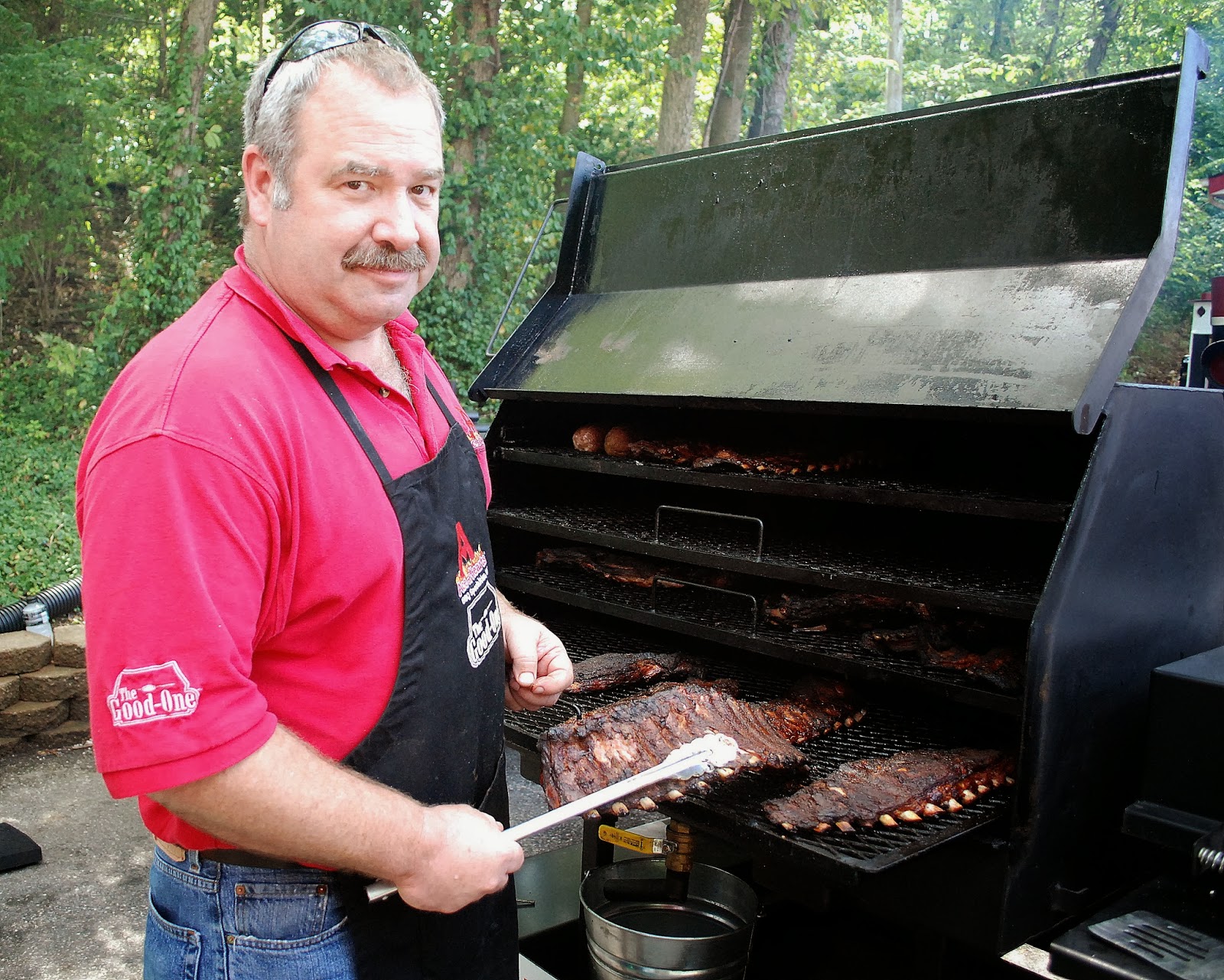
Chris Marks at one of his Good Ones
It’s not every day when I am able to sit down with an eight-time grand champion of the American Royal BBQ Cookoff in Kansas City. A while back, I had the pleasure of speaking with Chris Marks, chief cook of the Three Little Pigs barbecue team, while he was visiting Bloomington.

Marks was in town to offer support to our favorite hometown barbecue joint, Short Stop Food Mart, and to give cooking demonstrations and share recipes. He also brought along some things Hoosiers wouldn’t see unless they’re traveling, such as alligator.

Marks also is the winner of more than 40 national barbecue competitions, including at the Jack Daniels World Sauce Championship.

The Kansas City native was introduced to barbecue at a young age by his father Larry -- known as “Boss Hawg” – who created the Three Little Pigs team. “He was a great backyard barbecuer,” he recalled. 

It all began when his father received a smoker as a present after retiring from Hallmark in 1991. Soon, Larry entered a local contest and won his first ribbon. The family incorporated the team the following year.

“My Dad more or less was the ‘promotion guy.’ He was the guy walking around doing all the talking,” Marks said. “Me and my Mom were in the background doing all the cooking and it worked very well that way.” 

The Marks’ are friends with the “Baron of Barbecue,” Paul Kirk, and after Larry took one of his classes about smoking, the family never went back to grilling.

The younger Marks got his first taste of victory in 1993 in McLouth, Kan., beating out about 35 teams. “The excitement nearly caused my Dad to have a heart attack,” he remembered.

From that point on, the Three Little Pigs team tasted victory many times over a 10-year period starting in 1994. Chris took over the team after his father’s death in 1997.

A close up of what made Marks successful
But competition barbecue is different today, Marks noted. Back then, there were no consistent standards and specifications for the judges to follow. Judging was more subjective and based more on personal preferences about tastes.

“There was no judging training back then,” he said. “You better know how to cook well, because the judges just came off the streets. If they didn’t like it, you were toast.

“It would be interesting to see how the some of the teams that are doing well now would have done back 10 years ago.”

You may also have seen Marks on television programs such as “Taste of America” on the Food Network and “BBQ Battle” on the Travel Channel. He is fond of those largely unscripted shows which really showed how barbecue is done. “It was just smoke, no mirrors,” he added. “And it was an absolute ball.”

More recently, he’s observed that producers of some barbecue-themed shows are more into perpetuating stereotypes than really showing how it’s done. Shortly before we spoke, Marks had been in discussions with a network but was dropped from the project because he and others “weren’t Bubba enough.”

“We weren’t what they were looking for and they ended up putting on a guy on who cooked on a half-drum with overalls and beard and he flipped ribs,” he told me. “It about the perception out there.”

Today, Marks doesn’t compete very often. He is the face and chief consultant of Good One Manufacturing brand of smokers and grills – which has more than 200 dealers around the country -- and also sells natural lump charcoal, rubs and sauces. He travels with his wife around the country teaches at more than 75 BBQ Boot Camps last year.

This week, he is attending the Hearth, Patio and Barbecue Association Expo in Salt Lake City.

His parents developed the recipes for the rubs still sold today.
“It started out as my hobby and I turned it into a job,” Marks said. “I love what I am doing and I love teaching.”

The recipes for Three Little Pigs’ rubs were developed by his parents and the sauces were created as tribute to his father. Rather than one rub for all kinds of meats, his gluten-free rubs are separately designed for beef, pork and poultry. They sell three different sauces.

Much of what is written about barbecue focuses on particular states and regions, such as the Carolinas, the Deep South, Texas, Memphis and Marks’ home town of Kansas City. But with the growing popularity of barbecue nationwide, Marks has seen it migrating to new places where new regional flavors have been added.

For example, out West, in Arizona and California, he’s seen the pit flavors, but instead of tomato and vinegar-based sauces, people are using marmalades and other fruit glazes.

“You build a great flavor profile and then you put on it what you like,” he said. “It’s about the person. That’s what I teach and that’s what I want people to understand … You’ve got to develop your own style, you’ve got to make it personal.”

Marks is a purest. He prefers natural woods and charcoals over gas and wood pellets. He also understands why people in other regions may knock anything non-traditional.

“It all about adapting,” he said. “The great thing about Kansas City is we do all styles. We do them all and we really don’t care. Some other places, I tell you, they won’t budge but it’s their loss.”