|
| Hal Wagner, owner of Charcoal & More, right |
But as I learned recently at a “BBQ Bootcamp,” preparing good quality food over indirect heat isn’t all that complicated, especially when someone shows you the way.
Recently, I was among about 20 people who attended a four-hour class hosted by Hal Wagner, owner of Charcoal & More in Sellersburg, Ind. Our group included backyard barbecuers such as myself, as well as others who dabbled in competitions and even some who run the pits at restaurants (including Bloomington’s own Short Stop and Louisville’s Rob-a-Que).
“I guarantee a good time will be had by all, as well as the possibility of lapsing into a condition commonly referred to as the ‘Meat Sweats,’” Wagner told me when he extended the invitation to attend.
“We’re going to cook the way we like. We don’t know what you like yet, but that’s for you guys to figure out and we’ll help you along the way,” said Wagner, during his introductory remarks to the class. “We’re going to have some fun.”
 |
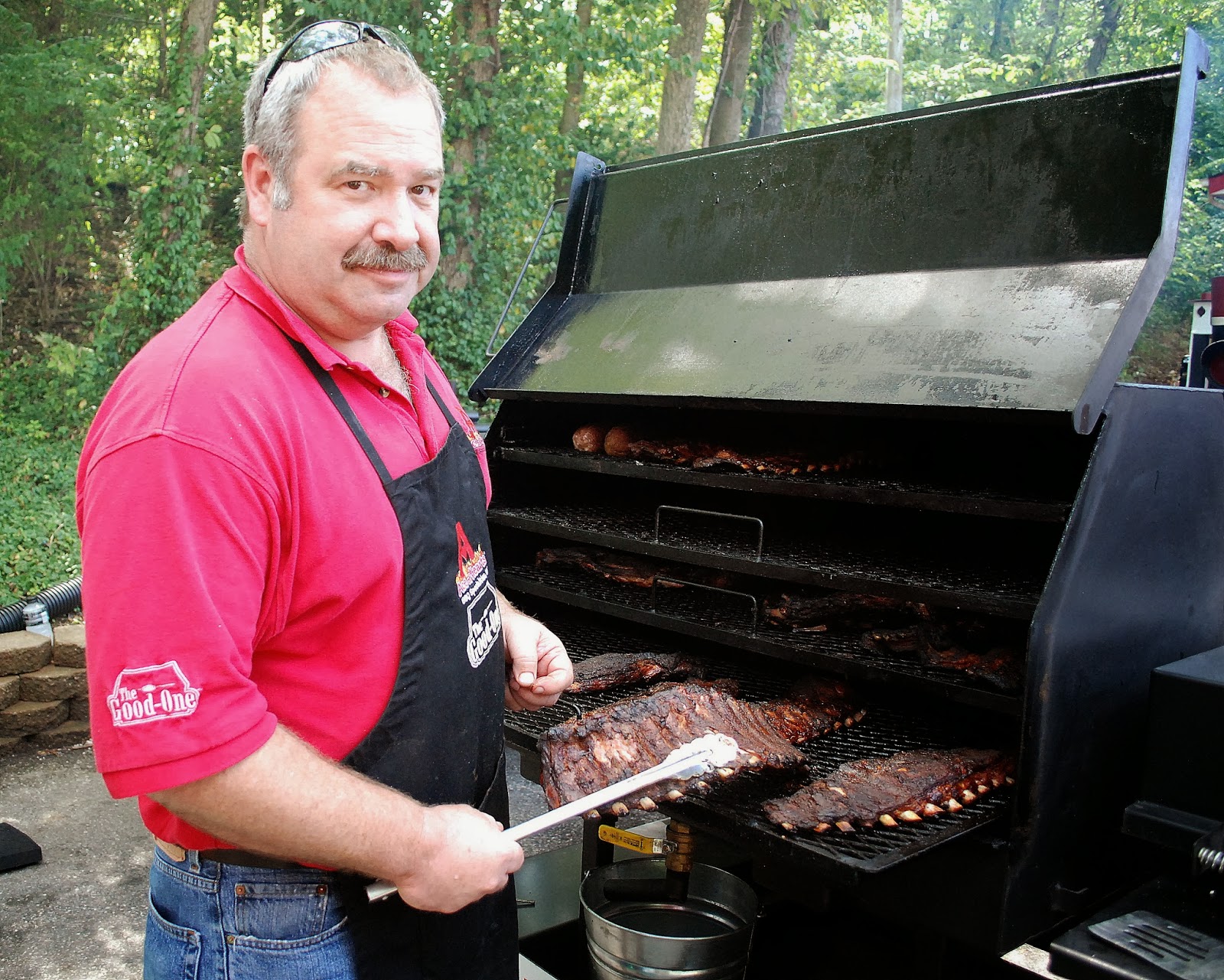
| Chris Marks demonstrates how to prepare ribs |
Our instructor was none other than
Chris Marks, winner of more than 40 barbecue competitions across the country,
including the American Royal Championship eight times, who I introduced you to
earlier this year. He teaches about 75 classes across the United States each
year.
“I love teaching barbecue and I love showing people how to do it right,” Marks said. “Where they take it, that’s what I want to hear. I have a lot of people from five or six years ago, when I started to teach classes, who’ve told me how successful they are. The thing that makes me the happiest is when some guy says, ‘My wife really liked this – this was the first time that she’s eaten my barbecue.’”
During the class, Marks used TheGood One brand of smokers, which he designed, but it wasn’t an infomercial. He demonstrated how to “build” baby back ribs, spare ribs, pork shoulder and chicken, beef brisket and scotch eggs in the smoker, which we then were able to sample.
“When we build a rib – notice that I said ‘build’ – we’re going to build it up into layers … We’re going to want to taste the meat. We’re going to want to taste the rub. We’re going to want to taste the smoke,” he told us. “Notice I didn’t say anything about saucing the meat, that’s where you personalize it.”
Out of respect for Marks, I won’t divulge too many of his class tips, but here are a few of his suggestions:
1. Avoid the "Texas Crutch"
Aluminum foil, which Marks and others call “the TexasCrutch,” shouldn’t be used because it parboils the meat. When you wrap your meat in the foil, it can lead to a “doughy bite” instead of getting something firm to bite into. All the fat and connective tissues have been rendered out along with a lot of the flavor.
“When you see ‘falling off the bone’ ribs, what do you see it in? Sauce. There’s a reason, because they know they’re dry,” he noted.
2. Remove the membrane and tenderize your ribs
After removing the membrane next to the bones, use a folk and poke holes through the meat between each rib. Not only does this tenderize the meat, but it will make them easier to eat later.
3. Have some mustard handy
Before applying your dry rub on the meat, put some yellow mustard on first to build your base.
 |
| A properly prepared rack of ribs |
Marks recommends using just plain old yellow mustard – no honey Dijon or Grey Poupon. The mustard acts as a binding agent between the meat and your spice rubs. It will cook completely off but will enable you to build a crust of flavors coming from your various rubs. This crust also will lock in juices, aka flavor.
4. Use the mustard and rubs, not marinades, to build flavor
“Understand this: meat is not a sponge,” Marks said. “If I sit there and spritz and spray it all day, is it going to be absorbed down into the meat? No. Pretty much what it’s going to do is wash away the work you did to build up a great rub.”
Marks is not a big fan of marinades, but believes that meat brines can be useful, particularly with chicken, turkey and hams.
In his rubs, Marks doesn’t use brown sugar because it tends to burn during the cooking process and can thus add a bitter flavor.
5. Watch your temperature to decide when to use wood smoke
A final tip: The nitrates and nitrites that come from the salt in your rub will interact with the pigment from the wood you are using to smoke your meat primarily when the meat temperature is between 140 and 150 degrees Fahrenheit. For most people, this happens during the first two hours of your cook.
 |
| BBQ Bootcamp offers ample opportunities for sampling |
Keep in mind that if you are cooking at a higher temperature
that your window for adding a smoked flavor will be much shorter as a result.
That’s why “low and slow” is more often preferred. Marks prefers to keep his
meat temperatures between 225 and 250 degrees at all times.
“As the meat cooks, that cell structure is going to relax and the better it’s going to be,” he said. “The slower that we can do it, the more flavor we’re going to enhance and the physics back that up.”
Adding more wood after the first two hours will have a tendency to make the outside of your meat darker, but won’t add more inside flavor (By the way, Marks is a “wild cherry kind of guy”).
Marks was very friendly and open to questions both during and after the class. “I help people all the time on the phone, even high-end restaurants who call me, wanting to know how to do it right,” he said, after mentioning that we could follow up with him later via email and Facebook.
Charcoal and More will be hosting another BBQ Bootcamp just outside of Louisville in Sellersburg, Ind., on Aug. 23-24. For more information, call 812-248-2233 or send an email to info@charcoalandmore.com.